BlogSEO · Google · Marketing
What is SEO? How it works, the main types and real results
Also available in: Azərbaycanca Русский

What is SEO, and why do some websites sit at the top of Google for years while others never reach page two? I have done hands-on SEO for e-commerce sites in Azerbaijan since 2014. This guide explains it in plain English, backed by Google's own documentation, published data and results from my own projects, and ends with ten steps you can take yourself today.
What is SEO? The short answer
SEO (search engine optimization) is the work of making a website easy for Google to understand, so that Google shows it in the free, organic results to people searching for what you offer. Unlike ads, organic positions can't be bought: you earn them with the site's technical quality, its content and its reputation.
Google puts it this way:
"SEO—short for search engine optimization—is about helping search engines understand your content, and helping users find your site and make a decision about whether they should visit your site through a search engine."
The definition has two audiences: the search engine and the person. A human still has to see your title, decide it's worth a click and find the answer. In my experience most sites fail at that second half.
Why SEO matters (a view from Azerbaijan)
Where I work, search means Google. StatCounter's figures for August 2026:
| Search engine | Share in Azerbaijan (August 2026) |
|---|---|
| 97.39% | |
| Yandex | 1.84% |
| Bing | 0.57% |
Source: StatCounter Global Stats. Customers here search in both Azerbaijani and Russian, so a bilingual site needs pages built for the searches in each language.
Second, the top positions take most of the clicks. Backlinko analysed about 4 million Google results using Semrush data: the #1 organic result has an average CTR (click-through rate, the share of people who see a result and click it) of 27.6%, and the top three results together get 54.4% of all clicks.
"The #1 organic result is 10x more likely to receive a click compared to a page in the #10 spot."
Third, organic traffic isn't paid per click. Google Ads traffic stops when the budget does; an earned organic position keeps sending visitors for months or years. On Təkərevi.az, organic search alone brings 25–30K AZN of revenue a month, with nothing paid per click.
How SEO works: Google's three stages
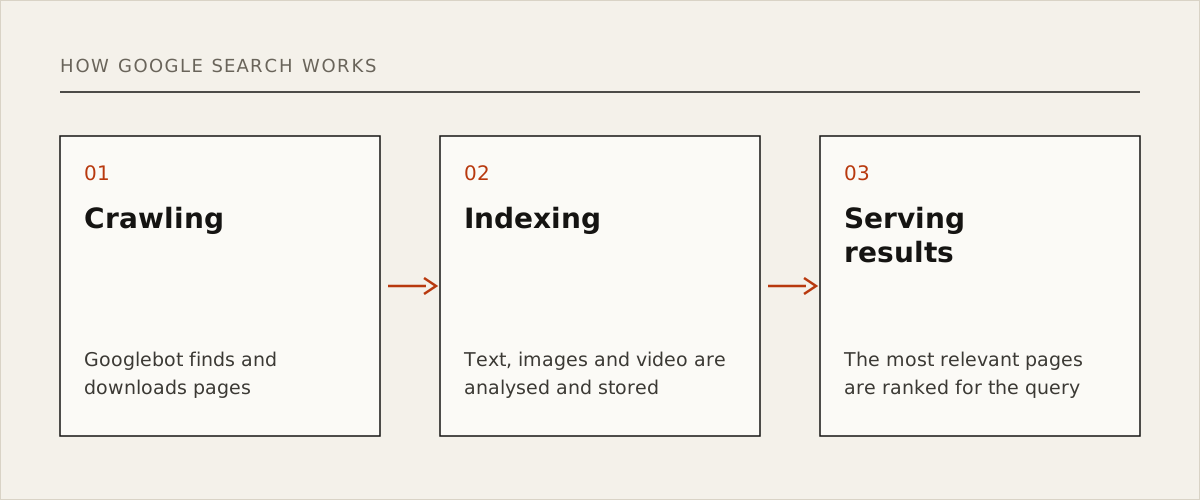
To understand how SEO works, you need to know how Google finds, stores and shows a page:
"Google Search works in three stages, and not all pages make it through each stage"
1. Crawling
"Google downloads text, images, and videos from pages it found on the internet with automated programs called crawlers."
So Google has to find the page first. If nothing links to it, it isn't in your sitemap.xml, or robots.txt blocks it, the crawler may never get there. New online shops often hide products behind search and filters, with no plain links from category pages.
2. Indexing
"Google analyzes the text, images, and video files on the page, and stores the information in the Google index, which is a large database."
Found isn't the same as indexed. Near-duplicate pages, empty categories, a stray noindex tag or content that appears only after JavaScript runs keep pages out. Search Console's Pages report shows which URLs aren't indexed and why.
3. Serving results
"When a user searches on Google, Google returns information that's relevant to the user's query."
This is where ranking happens: Google picks the pages in its index that answer the query best. Language, location and device matter too, so someone typing "tyres" on a phone in Baku sees different results from someone on a laptop in another country.
Money doesn't speed up any of these stages:
"Google doesn't accept payment to crawl a site more frequently, or rank it higher."
Ads are shown separately and labelled as ads. Organic positions are not for sale.
The main types of SEO
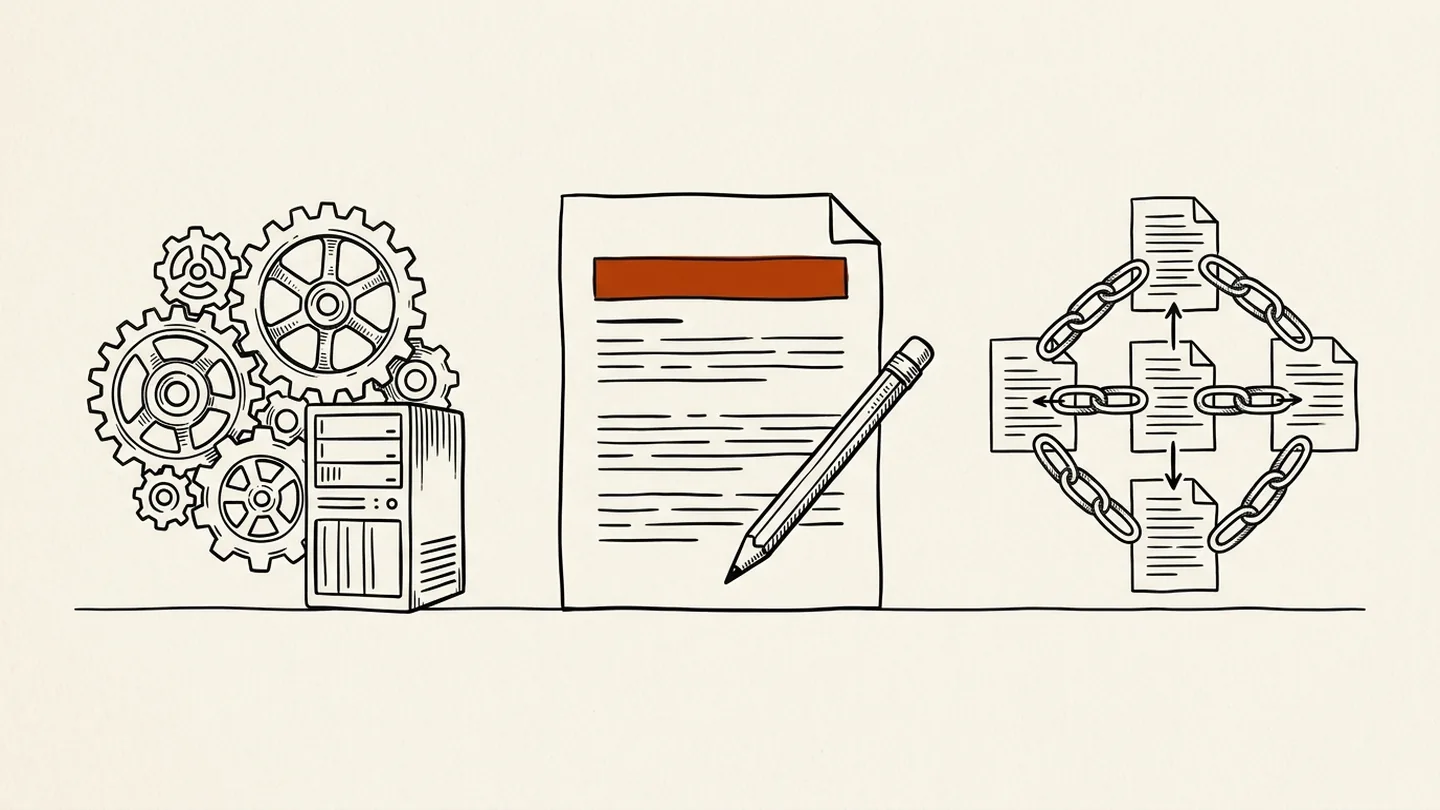
I split SEO work into three areas: technical, on-page and off-page. A business with a physical location adds a fourth, local SEO.
| Type | Where it happens | Examples |
|---|---|---|
| Technical SEO | Server, code, site structure | Speed, HTTPS, sitemap, canonical tags, schema |
| On-page SEO | The page itself | Title, headings, copy, images, internal links |
| Off-page SEO | Outside your site | Backlinks, brand mentions |
| Local SEO | Google Maps and local results | Google Business Profile, reviews |
Technical SEO
Technical SEO lets Google crawl and index the site and gives visitors fast pages. As a developer, I fix this part in the code rather than hand over a list. Checklist:
- HTTPS everywhere; HTTP and www variants 301-redirect to one address.
- Fast pages on phones, with Core Web Vitals (Google's speed and stability metrics) in the "good" range in Search Console.
- A mobile version that works end to end: menu, filters, cart, checkout.
- An automatically updated
sitemap.xmlsubmitted in Search Console, and arobots.txtthat blocks nothing you need. canonicaltags on duplicate pages pointing to the main version.- Removed pages return 404 or a 301 to a relevant page, with no redirect chains or loops.
- Schema.org structured data for products, prices, availability and breadcrumbs.
hreflangtags linking the language versions. On Azerbaijani sites that run in az, ru and en, this is the most commonly forgotten fix.
On-page SEO
On-page SEO is everything on the page itself: content, headings, meta tags, images and internal links. The goal is a page that fully answers one search intent. Google's standard is short:
"The content is helpful, reliable, and people-first"
On-page checklist:
- A unique
titleon every page, with the main keyword near the start. - A meta description that says what the page offers; Google often shows it under the title.
- One H1, with H2 and H3 for the structure.
- Short, readable URLs:
/tyres/summer, not/index.php?id=123. - Copy that answers the real question: sizes, terms, delivery, warranty, comparisons.
- Your own product descriptions, not the manufacturer's.
- Compressed images (WebP), each with
alttext. - Links to closely related pages on your site.
Off-page SEO
Off-page SEO is what happens outside your site and shapes its reputation, above all backlinks: links from other sites to yours. Each link works as a recommendation, and one from a relevant site with real readers outweighs a hundred random ones.
- Manufacturers, distributors and partners link to you.
- News sites and industry portals mention you because there is real news or useful material.
- People search Google for your brand name directly.
- Your link profile looks natural: no sudden spikes, spam directories or link "packages".
Local SEO
If you have a shop, an office or a service area, showing up in Google Maps and "near me" results is a separate job, built around your Google Business Profile:
- The profile is verified and the primary category is right.
- Address, phone and opening hours match across your site, social media and directories.
- Real photos of the shop, products and team are uploaded.
- You ask customers for reviews and reply to every one.
SEO vs SEM: what's the difference?
SEM (search engine marketing) technically covers both SEO and paid search ads, but in everyday use it means Google Ads. Side by side:
| SEO | SEM (Google Ads) | |
|---|---|---|
| Cost model | Clicks are free; you pay for work and content | You pay for every click |
| Speed | Weeks, usually months | As soon as the ad is approved |
| When you stop | Positions decline gradually | Traffic stops the same day |
| Where it shows | Organic results | Labelled as an ad, usually on top |
| Long-term value | Compounds: content and links stay | Resets when the budget runs out |
| Best for | A lasting business, steady traffic | New sites, campaigns, testing |
You don't have to choose. A new site can sell through Google Ads while the SEO foundation is built, and the ad data shows which search terms bring orders.
How long does SEO take?
It's the question I get most often, and Google's answer is honest:
"Some changes might take effect in a few hours, others could take several months."
Fixing a technical error, such as a section blocked by mistake, pays off once the pages are recrawled. A new site climbing for competitive terms takes months, depending mostly on the competition, the site's age and its starting point.
An example: in 2024, a two-month SEO campaign for Jouwanni.az, an online perfumery built on Laravel that I worked on, brought 250–300 visitors a day. That's a fast result, not a norm for every site. If someone promises you an exact timeline and an exact position, read the red flags below.
Real results from Azerbaijan
Here is what my own projects and my clients' signed letters show.
Təkərevi.az (Level Up LLC, an online tyre shop). I built the site and have run its SEO since 2014. For years it has held top-three Google positions for the most competitive keywords in its industry, and it has been the market leader for more than ten years. Organic search alone brings 25–30K AZN of revenue a month. The work covers the full range: on-page and off-page SEO, schema markup, page speed, Google Analytics and conversion tracking. The CEO, Oktay Ahmadov, wrote in a signed letter dated 5 January 2026:
"Under his technical and strategic leadership, our website has consistently ranked within the top three search results for highly competitive industry keywords for many years."
Granite.az. I built the e-commerce platform from scratch and ran the SEO strategy. The company's CEO wrote in a signed letter dated 23 December 2024 that this strategy "has kept us as the market leader in our sector for years".
The LevelUp years (2018–2020). Projects I worked on reached 100,000+ monthly users.
More detail is on my projects page, and the scanned letters are in the recommendations section of the home page.
What an SEO service includes
An SEO service is ongoing, measured work to win traffic and sales from organic search, not a one-off "optimisation". A properly run service usually covers:
- Audit. Technical health, indexing, speed, content, link profile and a comparison with competitors.
- Keyword research. What customers actually type into Google, with each query mapped to a page; in Azerbaijan, usually in Azerbaijani and Russian.
- Technical fixes. Everything the audit found: redirects, speed, sitemap, canonical tags, schema, hreflang.
- Content. Category and product copy, service pages, articles that answer customers' questions.
- Internal and external links. A logical internal structure and natural, relevant backlinks.
- Reporting. From Search Console and Analytics: queries, positions, traffic and, above all, orders or leads.
Red flags when hiring for SEO
- "I guarantee the #1 spot." Nobody can honestly promise that. Google says so itself:
"There are no secrets here that'll automatically rank your site first in Google (sorry!)."
- Paid link packages. "100 backlinks for a fixed fee" usually means links from spam sites that can hurt more than help.
- Invisible work. No reports, no explanation of what was done, no access to Search Console.
- Accounts in someone else's name. Your domain, hosting, Search Console, Analytics and Google Business Profile should belong to you, not the contractor.
What SEO costs depend on
I won't quote numbers, because very different amounts of work are sold under the same "SEO service" label. The price depends on:
| Factor | Why it changes the price |
|---|---|
| Competition | If competitors have invested in SEO for years, overtaking them takes more work |
| Site size | A 10-page company site and a shop with thousands of products are different jobs |
| Technical state | An old or broken site needs fixing first, sometimes a rebuild |
| Content volume | Who writes the copy, and for how many pages |
| Number of languages | Each language means separate keyword research and content |
| Geography | Local SEO for one city differs from SEO for a whole country |
| Off-page needs | Earning links from reputable sites takes time and contacts |
| Format | A one-off audit, a fixed-term project or monthly ongoing work |
Before comparing quotes, ask what work will be done, how results will be measured and what the reports will look like.
10 steps you can take yourself
This list follows Google's own advice and the mistakes I've seen most often since 2014:
- Add your site to Google Search Console and verify ownership. It's free and shows how Google sees your site.
- Submit your
sitemap.xmlin Search Console. - Open the Pages report and check which URLs aren't indexed, and why.
- Write a unique title and meta description for every important page.
- Test speed with PageSpeed Insights and compress large images first.
- Place a test order on your own site from a phone.
- Write content that answers customers' real questions: type your topic into Google's search box and note the suggestions.
- Link your pages together: from articles to services, from categories to products.
- Create a Google Business Profile, or fill in every field of the one you have.
- Once a month, open the Performance report in Search Console and check your queries, CTR and positions.
FAQ
What is SEO in simple terms?
SEO is the technical, content and reputation work that helps a website rank higher in Google's free results.
Is SEO free?
Organic clicks are free, and Google doesn't sell rankings. But SEO itself takes work: you either put in the time yourself or pay a specialist.
How long does SEO take to work?
In Google's words, some changes take effect in a few hours and others take several months. Technical fixes pay off quickly; rankings for competitive terms take months.
Can I do SEO myself?
Yes, especially on a small site; the ten steps above are a solid start. Large shops, multilingual sites and competitive niches usually need a specialist.
What's the difference between SEO and Google Ads?
Google Ads brings traffic at once and stops with the budget. SEO is slower, but organic clicks are free and earned positions last. They work best together.
Bottom line
SEO isn't a secret or a trick: it's steady work that lets Google find, understand and show your site. If you want an audit or ongoing SEO, read about my SEO service and get in touch.